
As a clinical student you are expected to start to develop your clinical acumen by seeing patients and learning from these encounters in a clinical environment. This experiential learning is fundamental to your development as a doctor and just as important for your assessments, the online case-based-learning, your own reading and revision. Learning by experiences in this way is powerful because the patients and their problems make a real and lasting impact in your memory. However experiential learning also brings its own challenges:
- Even across the huge diversity of learning environments and opportunities that are made available to all students by the Medical School and its NHS partners, it is impossible to guarantee that you will experience the same balance of patients as each other.
- This variability is fundamental to the nature of healthcare delivery and is reflected in your placements. You will not receive exactly the same placements in Medicine or Surgery as each other in Year 3.
- Experiential learning is opportunistic and therefore can be tricky to negotiate to provide the structure that is required to make learning relevant and understandable.
- It requires you to be proactive in seeking out opportunities for learning from these environments, interacting with as many patients as you can on a daily basis.
To support this, you will engage in learning through a combination of methods and approaches that together will allow you to meet the diverse requirements of your medical degree. Core to all these are your clinical placement blocks. There are five placements over 24 weeks in Year 3.
Introduction to Clinical Learning (ICL) – 4 weeks
An initial 4-week ICL Block provides you with the opportunity to learn examination and procedural skills, whilst spending time in the clinical environment to understand the roles of other healthcare professionals and integrate into the clinical team. With this grounding, you will start your clinical placements with a role within the clinical team.
The aim of the ICL block is to familiarise you with the clinical environment, and to ‘frontload’ you with the skills you will need on a day-to-day basis during placements so that you can feel confident to involve yourself within the clinical environment. It will also allow you to familiarise yourself with the logbook requirements required to formally pass the clinical placements with a satisfactory outcome.
Clinical Placements – 4 Blocks of 5 weeks
Throughout Year 3 you will be attached to one of 4 Clinical Education Campuses (CECs). Each CEC has an allocated teaching hospital which will serve as ‘basecamp’ and clinical placements will either be there or at one of their associated hospitals.
The 4 NHS Teaching Foundation Hospitals for Manchester medical school are:
- Manchester University NHS Foundation Trust (MFT) Oxford Road Campus
- Manchester University NHS Foundation Trust (MFT) Wythenshawe Hospital
- Lancashire Teaching Hospitals NHS Foundation Trust
- Northern Care Alliance NHS Foundation Trust
You will rotate through 3 General Medicine placements and 1 General Surgical placement during Year 3, each of 5 weeks duration. The aim of these placements is to give you experience of clinical medicine in a hospital setting. It will also give you opportunity to apply the knowledge you have been amassing over Years 1 & 2 of your studies, apply clinical examination and procedural skills, refine your patient assessment abilities and to develop and improve your clinical reasoning.
What you can expect from a Year 3 clinical placement:
Whilst on your clinical placement blocks the expectation is that you spend 60% of your time in the clinical environment. It is crucial to note that this time may not specifically be written in your timetable as each placement will be different. When you have nothing allocated in the timetable, you are expected to go to your allocated wards and ask the ward doctors/ nurses to see suitable patients, read their notes, and offer to support ward activities that are within your competency. The remaining 40% of your time will be attending mandatory clinical teaching sessions or private study outside the clinical environment.
You will be allocated a Clinical Placement Supervisor (CPS) for each clinical block:
- You will be notified in advance of your placements for you to make arrangements for travel.
- You will be allocated a CPS whose responsibility it is to meet with you and to supervise your placement. Your CPS is trained in their role and will be required to sign you off at the end of each placement. If they are unavailable for any reason, the programme requires the CPS to provide an associate placement supervisor.
- Your CPS manages your placement together with the local CEC team.
- Your CPS or associate will provide you with a timetable in advance of your clinical placement starting. Please remember that the timetabling is extremely complex and subject to change at short notice due to the nature of clinical work. Your CEC oversees this and will do their utmost to minimise disruption or cancellations and will try to organise alternatives to the best of their abilities, but this is not always possible and so you should be prepared to seek out learning opportunities yourself as well.
- Your CPS and clinical team in placement will support you in making the most of learning opportunities available in the placement.
- Your CPS and clinical team will ensure minimum placement requirements are delivered for all students.
- Your CPS and clinical team will organise core clinical teaching activities and supervisor meetings with each student.
- Your CPS will allocate an associate to take their place if they are absent/on leave.
- Your placement timetable provides a guide to what clinical learning activities are accessible on placement.
- You will ALL have defined teaching in patient assessment and other clinical examination skills and be provided with the opportunity to work with other members of the clinical teams.
- You will have time set aside to read and prepare for the teaching sessions on Fridays.
- It is recommended that you complete at least four hours of clinical work outside of Monday- Friday 8am-5pm once per Block (Blocks 1-4 only) to experience the ‘out-of-hours’ on-call service.
- You will have time to seek learning opportunities for yourself on the wards.
These are minimum requirements for each placement. These have been defined and agreed by the MBChB programme and our NHS partners. You will be asked to complete an evaluation of each placement and the feedback you provide will be used to improve those placements. Please give honest, constructive feedback and suggestions for improvement. The Year 3 Academic team review all feedback and comments during the year.
What we expect from you in a placement:
During your clinical placement blocks we have the following expectations of you as students:
- Prior to your induction and orientation meeting with your CPS, identify your intended learning objectives (ILOs) for the placement based on:
- Identified gaps in your personal learning (consider the feedback from previous assessments and supervisors);
- the ILOs for the semester and block, including the undergraduate procedural skills assessments (UPSAs) and tasks and bring this information to your initial meeting with your supervisor in order to agree appropriate ILOs for your placement.
- Attend all your clinical placement sessions and formal teaching and learning activities as per your timetable (with attendance in line with programme requirements – 100% attendance is expected).
- If you are absent for any reason (such as illness), you are expected to complete an absence E-form on the same day as well as informing your CPS and your CEC administration team.
- Assume responsibility for patients consistent with your level of training.
- Complete a minimum average of 3 patient assessments per week (or more) during each placement as this is a requirement for successful sign-off. These should be documented using the patient assessment E-form available via your iPad.
- Provide evidence in your logbook that you have completed a minimum average of 1 presentation of patient assessment per week per block. This equates to a minimum of 4 ‘standard’ presentations to a Doctor (FY1 or above) or Specialist Nurse with Advanced Nurse Practitioner qualifications PLUS 1 ‘enhanced presentation’ to your CPS.
- Complete mandatory UPSAs and Prescribing and Medicine Safety Skills as defined by the Year 3 ILOs and outlined in 1MedInfo.
- The student is responsible for providing evidence through their logbook to demonstrate they are satisfactory in their performance and engagement in learning.
- Achieve a satisfactory placement sign off at the end of your placement.
- Ensure that your placement sign-off e form is submitted within the last 3 days of the placement by 5pm on the last day of your placement at the latest after the final meeting with your supervisor.
- We expect you to notify the CEC administrator of any delays to your end of placement sign-off.
- We expect you to dress appropriately, attend on time and behave in a professional manner at ALL times including during any virtual teaching sessions.
- Any professional leave MUST be approved by the hospital dean and your CEC Year Lead in advance of organising the leave. You should also inform your CPS of any approved leave at the beginning of the placement or at the earliest opportunity.
What constitutes a ‘Satisfactory’ grade in a SINGLE Year 3 Clinical Placement Block?
Decisions are made on the basis of the evidence that you provide. An electronic logbook has been created to support you to achieve this. It is your responsibility to show your CPS how you have performed in the placement.
At the end of each clinical placement block you will have an End of Placement meeting with your CPS. This meeting will give you a chance to reflect on what you have learned during your clinical placement and constructively identify future learning needs. During this meeting your CPS will review your logbook to ensure that you have met the required targets.
During your End of Placement meeting your CPS will be required to mark your placement as either ‘Satisfactory’ or ‘Unsatisfactory’.
Your Supervisor will meet with you at the end of your placement to make a summative assessment based upon the following components:
- Your attendance at teaching – have you attended the required timetabled teaching and learning sessions? CPSs will have access to the number of TCD, CD and SCT sessions you have missed during the placement.
- Your patient assessments – your placement will be automatically marked unsatisfactory if you have not done the minimum number of assessments (see below)
- Engagement and professionalism – your CPS will make a global judgement as to your professionalism and engagement in the placement, for example attendance at placement teaching and bedside teaching and punctuality.
Your CPS will use the entries in your logbook and your attainment of the MINIMUM requirements as evidence:
- 3 self-assessed patient assessments per week.
- 1 presentation of patient assessment each week to a doctor or nurse specialist (standard presentation), one of which must be an enhanced presentation of patient assessment per block to the CPS.
- 1 formal systems examination per week observed by a clinician who performs the skill in their own practice.
- Adequate progress with completion of UPSAs and Prescribing and Medicine Safety Skills assessment.
- Your attendance at mandatory teaching sessions during the clinical placement, including the number of TCD and CD sessions, and Secondary Component Teaching.
- The CPS will draw on their own experience and feedback from their team as to your attendance and engagement within the placement, as well as your professionalism, probity and integrity.
Your supervisor will also give you some formative feedback for your clinical skills, medical knowledge and interpersonal skills and teamworking. This will be useful for you when discussing and agreeing ILOs for your next clinical placement with your new CPS.
Your CPS should sign off your form within the last 3 days of the placement. If this cannot be completed due to the CPS being unavailable, the supervisor’s deputy should sign this off. In case of any difficulties, the CEC Year Lead will assess the student’s logbook to determine a grade and submit the form. The latest possible date for submission of a form post-placement is 5 working days. After this date, the student’s placement will be considered unsatisfactory.
What constitutes an overall ‘Satisfactory grade’ in the Clinical Placement Blocks ACROSS the Year?
A satisfactory grade for each Block 1-4 (see below image for outcome if 1 or more Block outcomes are unsatisfactory),
PLUS
- Completion of all assessed UPSAs and Prescribing and Medicine Safety Skills by the end of Block 4.
- No concerns regarding your overall attendance and/or engagement as assessed by clinical supervisors and faculty at your CEC.
What happens if you do not meet these requirements?
An ‘Unsatisfactory’ grade helps us to identify and provide assistance for students who may require extra support in their studies. If you receive an ‘Unsatisfactory’ grade for one of your clinical placements, your CEC lead will meet with you to discuss this further and agree objectives for the subsequent Block. They will ask your next supervisor to make a judgement on whether you have addressed any issues identified previously and met these agreed objectives.
The image below outlines the consequences of failing to meet the requirements to pass your clinical placement blocks. If you do not meet the requirements by end of Block 4 you will not be able to choose your SSCP placement and will be assigned a mandatory SSCP placement in order to have the opportunity to remediate in a supportive clinical placement. If a student fails to complete 4 or more skills assessments (UPSA and/or Prescribing and Medicine safety skills) by the end of block 4 they will be required to remediate in a mandatory SSCP that offers the best opportunities to complete the outstanding skills.
If you do not complete the requirements during this period, you will be deemed unsatisfactory for your Clinical Placements Blocks overall and may not progress to Year 4. This will be determined by the Year 3 Exam Board.
If a student is graded unsatisfactory in 3 or more clinical placement blocks, their studies will be discontinued and they will be required to re-sit Year 3 at second attempt.
Mitigating circumstances can be applied for a block failure. If accepted they will not change the outcome of that placement nor educational requirements to remediate, but if there is consequent failure of remediation it will determine whether Clinical Placements in a repeat year will be at 1st or 2nd attempt. For details of how this is applied please visit the Year 3 Progression Page.
Remediation process if you fail 1 or more Clinical Placements or do not complete your UPSAs and/ or Prescribing and Medicine Safety (PMS) assessments by Block 4
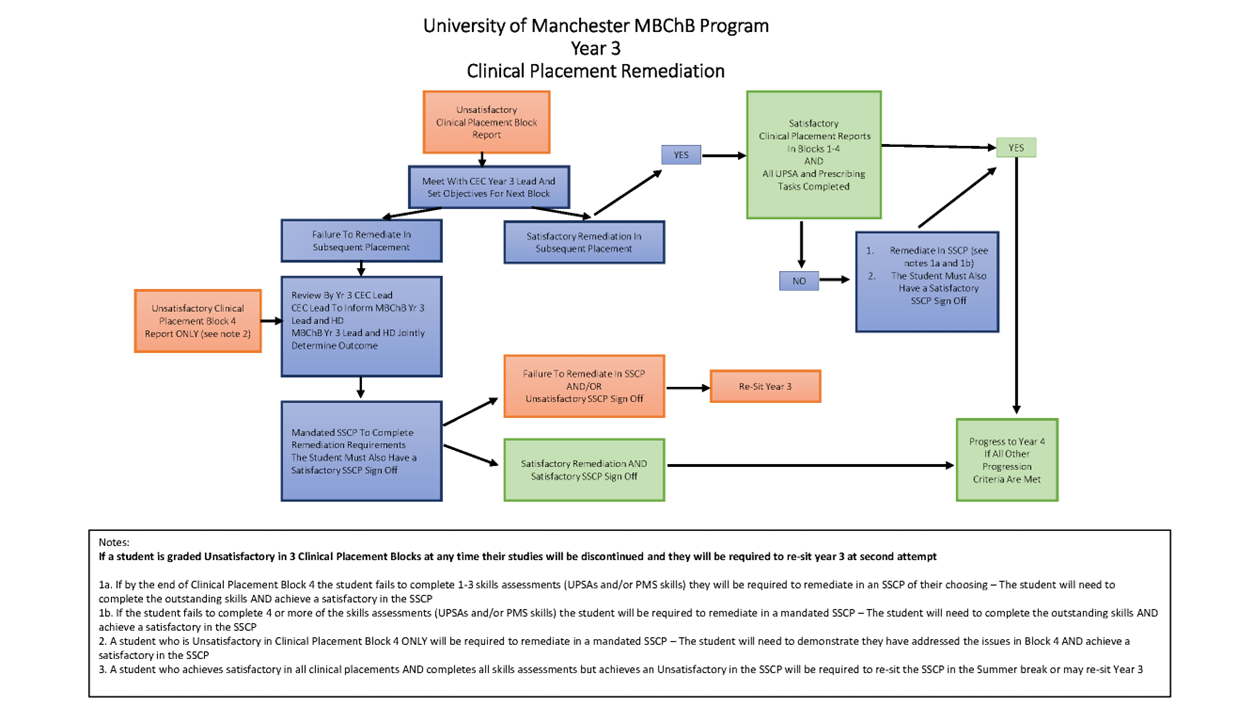
(Click on the image to enlarge and read it)