
Clinical Placement Blocks are Medicine, Surgery, Acutely ill, GP and the Student Assistantship (SA) placement. QEPEP is not a Clinical Placement Block. (See separate QEPEP information on 1Med)
Immediate Life Support (ILS) Course
In Year 5, you will have two opportunities to attend and pass a mandatory Immediate Life Support (ILS) course provided by the University. Failure to do so will mean you have not fulfilled the requirements for Year 5 clinical placements and skills and you will need to self-arrange and self-fund an ILS course or equivalent prior to graduation to demonstrate the relevant GMC, Outcomes for Graduates, 2018, Outcome 17. Please contact your CEC Year Lead to discuss an alternative course prior to booking to confirm this meets programme requirements.
Clinical Placements Blocks 1-4
During your placements prior to Final exams, it is expected that you will be fully immersed in the clinical environment. You will rotate through four areas of practice: medicine (5 weeks), surgery (5 weeks), acutely ill (5 weeks), and general practice (5 weeks). These rotations will be followed by two weeks of revision activities and one week of personal study, prior to Final exams. Students are advised not to book travel home in these weeks.
Successful completion of all the clinical placements is required prior to graduation. You will carry out, appropriately supervised, almost all the tasks of a FY1 doctor except those requiring registration with the GMC and a license to practice. You will NOT be permitted to authorise real prescriptions for medications under any circumstances (although you will have the opportunity to practice prescribing in your teaching and complete electronic prescriptions as part of your assessments), nor sign any statutory forms (e.g., Medical Certificate of Cause of Death, Cremation forms, statutory sick notes, etc.).
Not every clinical placement will be on a ward/GP practice where there is an FY1 doctor; however, you must assist a resident doctor and have duties similar to those undertaken by an FY1 doctor.
It is very important that you complete your placement sign off form correctly. Please:
1. Read the placement sign-off form before starting your placements.
2. Read the detailed guidance about this placement to ensure that you will be in a position to meet the strict criteria for placement sign-off: The Year 5 Clinical Placement Model on 1MedInfo
See: Clinical Placements Year 5 1MedInfo guidance
Placement Supervision
Clinical Placement Supervisor
A Clinical Placement Supervisor (CPS) is a senior doctor/clinician who provides you with personalised educational and professional support. Educational supervision is an important part of the Foundation Programme. The use of a similar system in Year 5 facilitates a seamless transition from your final year on the MBChB Programme to your Foundation Training.
Supervisors are there to help you:
- develop understanding and skills;
- recognise effective practice;
- encourage reflection on your practice and help you to identify areas for development;
- improve self-confidence.
Your supervisor should support you by providing:
- problem-solving support;
- professional information and advice;
- career advice, particularly about foundation training (or directing you to this).
Additional Clinical Tutors
You will be overseen by many other people, ranging from those in Foundation Year, to Consultants and GPs, and also by other experienced health professionals, such as nurses and pharmacists, all of whom may give some clinical oversight day-to-day on the ward/clinic. All these staff members are important sources of learning, support and guidance. They may be able to provide help and (where appropriately qualified) appraise/assess skills such as UPSAs and other work-based assessments.
What to do before a Placement
Contact your supervisor directly or through their secretary 1 week or more beforehand to arrange your initial meeting. As preparation for this meeting, start to identify some intended learning objectives (ILOs) for the placement based on:
- Gaps you have spotted in your personal learning (consider the feedback from previous assessments and supervisors);
- ILOs for the semester and block, including procedural skills, and bring this information to your initial meeting with your supervisor.
Please also note: you are expected to be registered with a GP at your term time address. In the event that you are placed for a block at the GP surgery where you are registered you should advise the community administrator at your Clinical Education Campus as soon as possible (see: Contacts). It is best practice to keep your work and personal contact with General Practice separate whenever this is feasible. Your personal data at your registered GP remains confidential.
What to do on starting your Placement
At the initial meeting with your supervisor you can discuss:
- Special needs, if you have any (from re-sit examinations to religious requirements);
- Your intended learning outcomes for the placement based on gaps in personal learning identified by you, informed by feedback from assessments and supervisors;
- Your placement timetable including participation in out-of-hours work;
- Who is their deputy supervisor if they are away;
- Dates for meeting for mid- and end of placement assessment/sign off.
- Completion of clinical skills assessments, including which UPSAs you plan to have signed off in this placement – You should complete these such that cumulatively you have at least 4-5 UPSAs signed off per clinical placement block. If by the end of the placement you are not on track with completion of your UPSAs, your Clinical Placement Supervisor will be required to highlight this to the Year 5 Academic Lead at your Clinical Education Campus.
During your time in medicine, surgery and acute illness experience, your timetable should include participation in shift work across the 7 day week, as afforded by each placement.
What to do during your Placement
Attendance is crucial: the expectation is that you will be present for 100% of your placement in order to get the most out of it.
You will be a member of the team working with allied healthcare staff, nursing staff and junior doctors. You will be expected to perform patient assessments with indirect supervision and record these in your logbook. You must complete at least 5 patient assessments each calendar week (on average) during each of your placements in blocks 1-4.
You will be expected to present your findings:
- At least one presentation of a patient assessment per week, recorded in your logbook, to any qualified doctor, physician associate, advanced nurse practitioner, specialist nurse of band 6 and above or allied healthcare professional
- A minimum of one enhanced presentation per block to your CPS or any other suitably trained (e.g. PRIME Clinical reasoning training or equivalent) Consultant (including nurse Consultant), General Practitioner or Speciality doctor.
You will build on your clinical reasoning skills to formulate appropriate differential diagnoses, develop your knowledge, and apply this to given situations including the selection of appropriate investigations and the interpretation of results. You should understand the principles of a holistic approach to patient management.
Take the opportunities given to throw yourself into teamwork: ask for and use a bleep, participate in on-call activities (especially out-of-hours evening and/or weekend work).
What to do at the end of the placement
When you attend your end of placement meeting with your clinical placement supervisor:
- Open up your dashboard for your supervisor to see on his/her computer and be prepared to talk through your patient assessments, presentations, UPSAs etc. This will act as an aide-memoire and help you to demonstrate your engagement, attendance, learning and progress with your ILOs.
- Your supervisor will then, all being well, be in a position to complete your placement supervision form.
You are responsible for ensuring that your end of placement form is completed and uploaded on the last day of your placement after the final meeting with your supervisor. The deadline for submission for this form is 5pm on the last day of the placement, unless there is accepted mitigation.
What constitutes a ‘Satisfactory’ grade in a SINGLE Year 5 Clinical Placement Block 1-4?
As you move into Year 5, the criteria for assessing engagement in clinical learning will reflect your growing independence as learners. You will be expected to provide evidence of your engagement in the Clinical Placement Block through the following criteria:
- Full attendance within placement and at the mandatory teaching and learning activities organised by the programme.
- Engagement in learning provided by evidence in your logbook of:
- A minimum of 5 patient assessments per week.
- A minimum of 1 signed-off patient assessment presentation per week, one of which in any given block should be an enhanced patient assessment presentation.
- Completion of a practice written communication document. These comprise of a surgical discharge document (surgical placement), a medical discharge document (medical placement), a referral letter (general practice placement) and a document used as part of transfer of care or request for consultation during your acute illness placement.
You are advised to complete at least 4-5 UPSAs per 5-week block of time cumulatively in term-time.
It is your responsibility to ensure your UPSAs are completed and allow time for them to be verified. If you have not completed your UPSAs by the end of placement sign-off this is considered a cause for concern regarding your professionalism and Clinical Placement Supervisors are required to highlight these to your Clinical Education Campus Year 5 Academic Lead .
Blocks 5 and 6
Blocks 5 and 6 each run over 4 weeks: Student Assistantship (SA) placement and a QEPEP placement (See separate QEPEP information on 1Med).
The Student Assistantship (SA) placement will help you strengthen your clinical skills, confidence, and professionalism in a supportive environment just before you step into your Foundation Doctor role. You will be based in a hospital within your Clinical Education Campus (CEC), closely involved in the daily life of resident doctors, and are expected to shadow, assist, and contribute to the team, following the GMC Student Assistantship model.
The SA placement is designed to:
- Provide you with practical exposure closely mirroring the day-to-day activities of foundation doctors.
- Enhance your confidence and competence in essential clinical skills through direct patient care and out of hours experience.
- Support development of your individualised learning objectives, focusing on areas where you feel less prepared.
- Offer a robust support structure with dedicated clinical supervision and feedback
Supervision and feedback
You will be supervised by a named consultant, the Clinical Placement Supervisor (CPS) to ensure engagement in patient care and learning objectives and facilitate integration into the team. You must meet with your CPS at the start, mid-point, and end of placement (EoP).
Your CPS will identify a Placement Supervision Group (PSG) to provide feedback for you. The PSG will include your designated resident doctor, for you to shadow and assist, and two additional team members eg a resident doctor, senior nurse, allied health professional, the deputy supervisor. You are required to seek feedback from the PSG which will be submitted directly to your CPS for discussion in your EoP meeting.
Placement structure
- This mandatory placement requires full attendance. Failure to complete will necessitate a remedial Block 7.
- You should plan for 32 hours per week of work. This should include a minimum of 8 hours out-of-hours experience over 4 weeks, structured flexibly. (Out-of-hours is defined as early and late/evening shifts and work at weekends).
- A further 8 hours per week will be assigned to mandatory teaching, portfolio, personal study and professional development
- You are required to attend a minimum of 12 hours mandatory teaching organised by the programme over 4 weeks, including core training (simulated on-call, documentation teaching, USS cannulation) and non-core (student-selected based on your learning needs).
Clinical Placement Supervisor meetings
At the initial meeting, your CPS will identify your Placement Supervision Group (PSG), including your designated resident doctor and two additional team members. You will create a Personal Development Plan (PDP), focusing on areas where you feel less prepared, and will review your UPSAs and practical skills, identifying any outstanding requirements. You will discuss your timetable, including participation in out-of-hours work.
At the midpoint meeting, your CPS will review your attendance, engagement and professionalism including progress with your PDP, UPSAs, teaching and feedback collection. If feedback is incomplete, you must email your PSG (with copy to CPS) and request feedback. The midpoint meeting is a good opportunity for you to present your enhanced patient presentation to your supervisor.
At your end of placement meeting, your CPS will verify your attendance, engagement and professionalism. You will have the opportunity to reflect on progress with your PDP and discuss the feedback from your PSG.
Requirements for a satisfactory grade in the Student Assistantship
- Full attendance within the placement, including 8 hours out of hours experience and 12 hours mandatory teaching and learning activities organised by the programme.
- Engagement in learning provided by evidence in your logbook of:
- Review of your Personal Development Plan
- Feedback discussion with your CPS
- One enhanced patient presentation
- Completion of practical skills, including any outstanding UPSAs.
End of placement sign off for all clinical placements
In circumstances where the Clinical Placement Supervisor (CPS) has concerns about the student’s engagement (when evidence is lacking and/or as a consequence of feedback by colleagues), it is mandatory for this evidence to be reviewed.
Your supervisor should sign off your form by the final day of the placement. If this cannot be completed due to the supervisor being unavailable, the supervisor’s deputy should sign this off. In case of any difficulties, the CEC Year Lead will assess the student’s logbook to determine a grade and submit the form.
The latest possible date for submission of a form post-placement is 5 working days. After this date, the student’s placement will be considered unsatisfactory.
Where the CPS suggests a grade of ‘Unsatisfactory’, your Clinical Education Campus Year 5 Academic Lead will automatically be alerted by e-form notification. Your Clinical Education Campus Year 5 Academic Lead will review your record and meet with you to discuss the result.
What constitutes an overall grade of ‘Satisfactory’ in the Clinical Placement Blocks across the Year?
- Achieving a grade of ‘Satisfactory’ for each year 5 Clinical Placement Blocks (which may include Clinical Placement Block 7).
PLUS
-
- Evidence of completion of all required UPSAs by the end of your placement in Block 6 ( if not remediation and completion in a full Block 7).
- Evidence of completion of 1 practice written communication document for each of your Clinical Placement Blocks 1-4.
- Evidence of Immediate Life Support qualification.
- No concerns regarding your overall attendance and/or engagement as assessed by clinical supervisors and faculty at your CEC.
Unsatisfactory Clinical Placement sign off
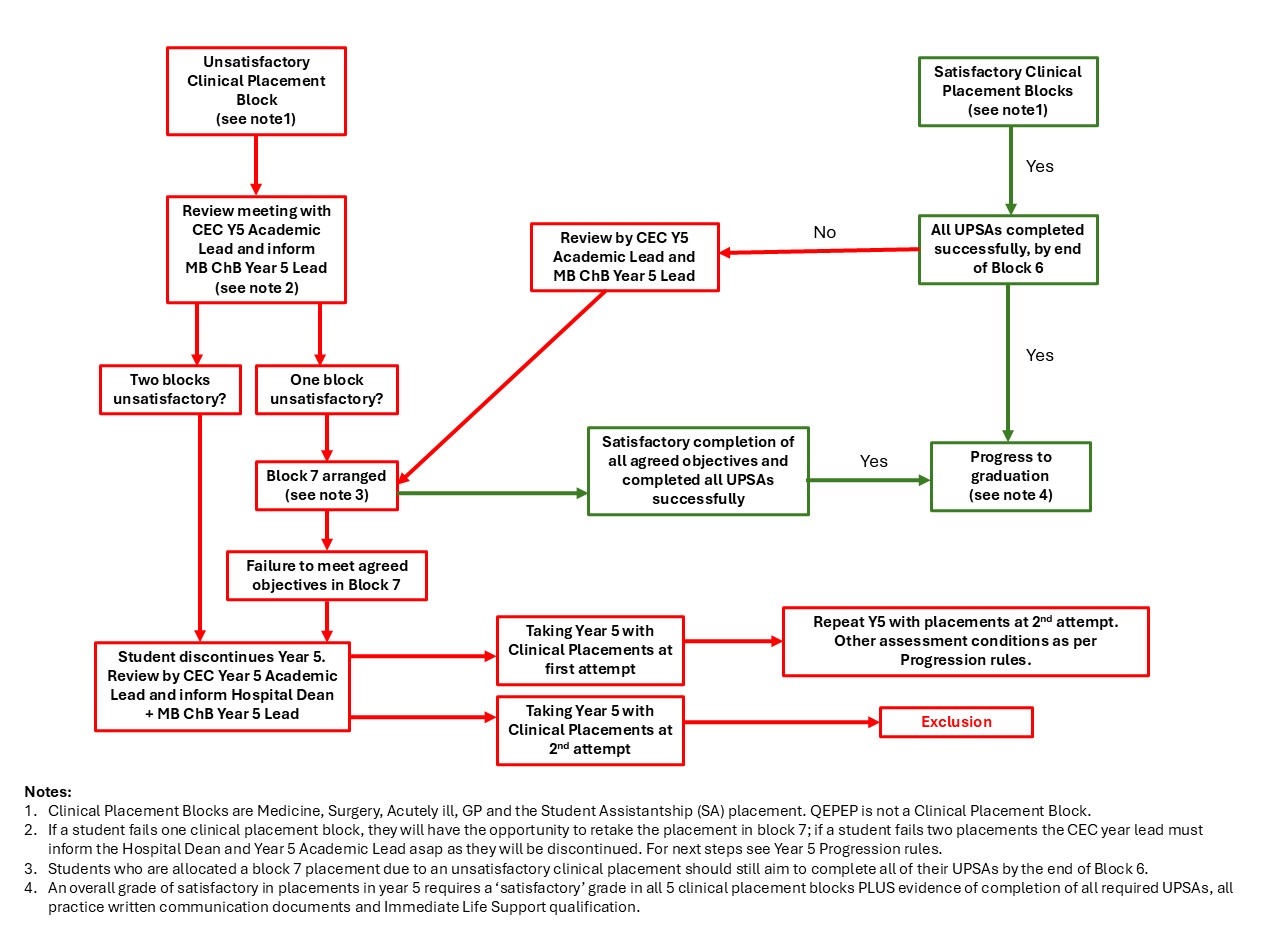
If you obtain a result of ‘Unsatisfactory’ for one placement block you are required to remediate in Block 7. You will meet with your CEC year lead and make arrangements for you to remediate your unsatisfactory placement outcome, normally by carrying out an additional placement at the end of the year, which would be referred to as ‘Block 7′. This will not always be a like-for-like placement, but will provide opportunities to address any particular issues that contributed to failure of the original placement.
The Progression Criteria for Year 5 outline what would happen if you have two unsatisfactory clinical placement blocks.
Mitigating circumstances can be applied for a block failure. If accepted they will not change the outcome of that placement nor educational requirements to remediate, but if there is consequent failure of remediation it will determine whether Clinical Placements in a repeat year will be at 1st or 2nd attempt. For details of how this is applied please visit the Year 5 Progression Page.
Please click on image to enlarge
Travel Bursaries
For information about travel bursaries and accommodation, please see follow these links:
MB ChB Programme Travel Bursaries
MB ChB Programme Policy -Travel and Accommodation for more Distant Placements in the Clinical Years